For jewelry brands, retailers, wholesalers, and private label businesses, finding the right diamond bracelet manufacturer is not simply a purchasing decision. It is a strategic choice that can influence product quality, development speed, inventory investment, pricing, and long-term business growth.
A professional jewelry factory can provide much more than finished bracelets. The right manufacturing partner can help develop new designs, create prototypes, select suitable materials, produce custom diamond settings, add branding, manage quality control, and prepare finished products for international distribution.
This is especially important for businesses that want to build their own jewelry collections instead of relying entirely on ready-made products. A custom manufacturing model gives brands greater control over product design and allows them to create bracelets for specific customer groups and price points.
Incepto Jewel provides OEM, ODM, private label, wholesale, and bulk bracelet manufacturing services, supporting businesses from initial product development through mass production and global delivery. Its bracelet factory currently lists more than 5,000 square meters of production space, over 100 skilled workers, a monthly capacity of more than 100,000 bracelets, and a typical MOQ of 30–50 pieces.
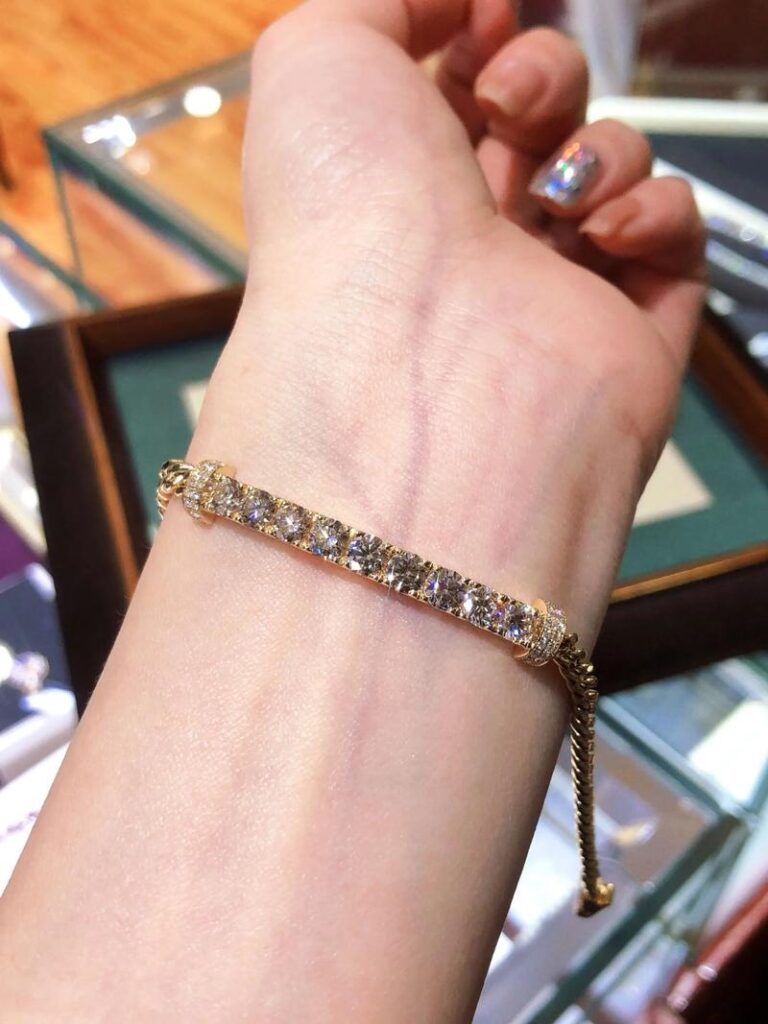
Why Jewelry Brands Work With a Diamond Bracelet Manufacturer
Jewelry brands often face a difficult balance between uniqueness and production efficiency.
Customers want products that feel distinctive, but creating every component independently can be expensive and time-consuming.
Working with an experienced diamond bracelet factory provides access to established manufacturing processes, technical knowledge, production equipment, and skilled workers.
Instead of building a production facility from scratch, a jewelry company can focus on product development, branding, marketing, sales, and customer relationships while the manufacturing partner manages production.
This model can be particularly useful for startups and growing online jewelry businesses.
A new brand may begin with a small collection of custom bracelets, test customer demand, identify the strongest designs, and then increase production for successful products.
Custom Manufacturing Creates More Product Differentiation
One of the biggest challenges in the jewelry industry is product similarity.
If multiple businesses purchase identical bracelets from the same catalog, competing primarily through price can become difficult.
Custom manufacturing provides another approach.
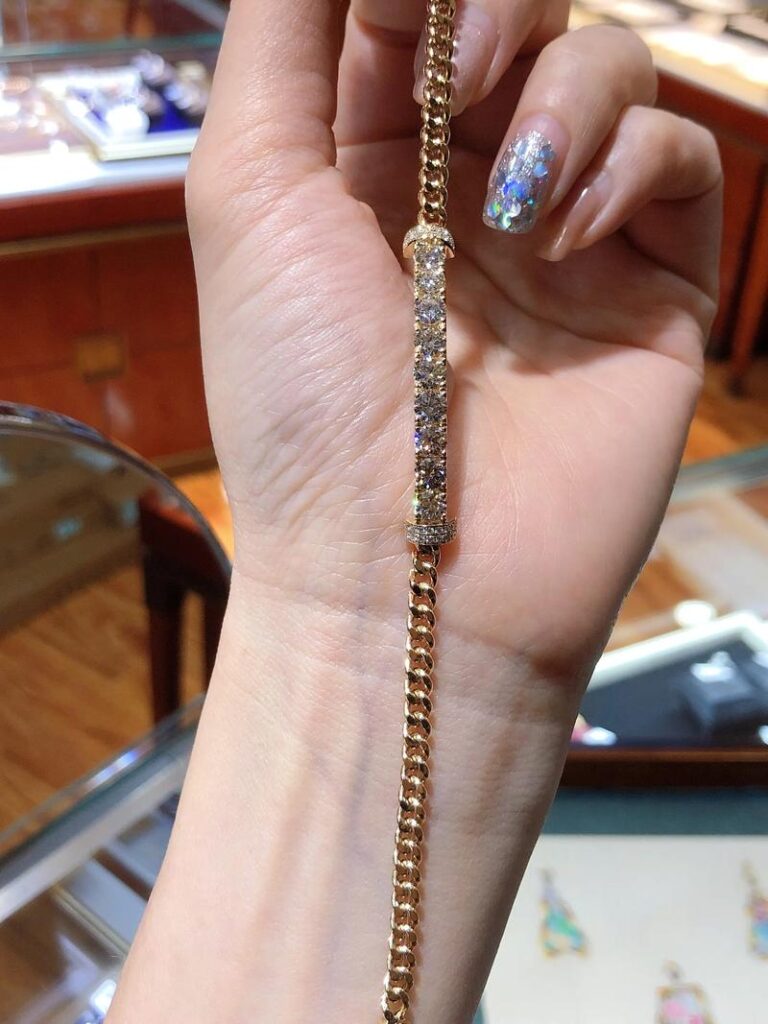
A brand can develop its own bracelet specifications, including:
- Bracelet dimensions
- Metal type
- Metal purity
- Diamond arrangement
- Stone size
- Clasp design
- Surface finish
- Logo engraving
- Packaging
- Product presentation
This allows the final bracelet to become part of the brand’s identity rather than simply another generic product.
For example, a brand specializing in minimalist fine jewelry might develop a slim diamond bracelet with a subtle logo and understated packaging. Another company targeting statement jewelry customers could develop a wider bracelet with a larger diamond configuration and more substantial metal construction.
The same manufacturing partner may be able to support both concepts while the brands maintain completely different product identities.
Natural Diamond and Lab-Grown Diamond Options
Diamond selection is an important part of product development.
Different customer groups have different expectations regarding diamond type, price, sourcing, and product positioning.
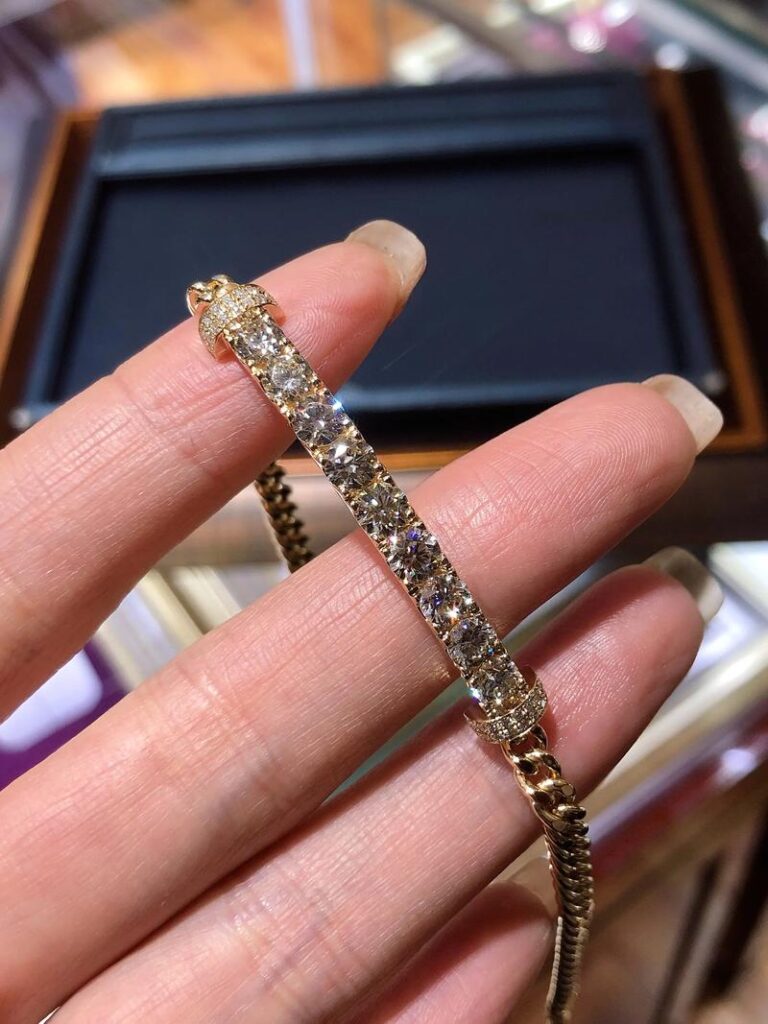
Natural diamonds remain a traditional choice for fine jewelry and luxury collections. Lab-grown diamonds offer another option for brands developing products around different pricing strategies and customer preferences.
Incepto Jewel’s bracelet manufacturing capabilities include both natural diamonds and lab-grown diamonds, along with moissanite, cubic zirconia, and natural gemstones.
This variety gives brands greater flexibility when developing multiple collections.
A business may choose natural diamonds for a premium collection while using lab-grown diamonds for another product line. The important point is to establish the stone specifications clearly before sampling and bulk production.
Selecting the Right Metal for a Diamond Bracelet
The metal used in a bracelet affects its appearance, durability, weight, positioning, and production cost.
Common materials include:
925 Sterling Silver
Sterling silver can be suitable for brands targeting accessible fine jewelry or contemporary designs.
10K Gold
10K gold provides a precious-metal option with a different balance between gold content and price.
14K Gold
14K gold is widely used for jewelry collections that require a balance of durability, appearance, and precious-metal value.
18K Gold
18K gold can be positioned toward higher-end fine jewelry collections.
Incepto Jewel lists 925 sterling silver, 10K, 14K, and 18K gold among its bracelet manufacturing materials, along with brass and stainless steel for other product requirements.
The right material should be selected according to the product’s target market, design, retail price, and intended use.
How a Manufacturer Can Reduce Product Development Risk
Launching a new jewelry design always involves some uncertainty.
A product may look excellent in a digital rendering but behave differently when turned into a physical bracelet.
This is why sampling is such an important part of custom jewelry production.
The manufacturing process can begin with a 3D CAD model. This allows the brand and manufacturer to evaluate dimensions, proportions, stone placement, and structural details before creating the physical sample.
After the CAD design is approved, a prototype can be produced.
The brand can then evaluate:
- Overall appearance
- Bracelet size
- Weight
- Wearing comfort
- Diamond placement
- Clasp operation
- Surface finish
- Logo position
- Packaging
If changes are needed, they can be made before bulk manufacturing.
This approach can reduce the risk of producing a large quantity of a design that requires significant modification.
From Prototype to Bulk Production
A reliable production process should create a clear connection between the approved sample and the final bulk order.
Once the sample has been approved, the final specifications should be recorded.
These specifications can include the exact bracelet dimensions, metal material, diamond requirements, finishing method, logo position, packaging, and other production details.
The manufacturer then uses the approved specifications as the reference for mass production.
Incepto Jewel describes an eight-stage bracelet manufacturing workflow:
- Design consultation
- 3D CAD design
- Prototype sample
- Material confirmation
- Mass production
- Quality-control inspection
- Secure packaging
- Global shipping
This one-stop process is designed to keep product development and manufacturing connected within one production workflow.
Low MOQ Can Help New Jewelry Brands Test the Market
Inventory management is one of the biggest challenges for a growing jewelry business.
Ordering too much inventory can tie up capital. Ordering too little can create stock shortages.
For new products, small-batch manufacturing can provide a useful middle ground.
A business can produce an initial quantity, introduce the bracelet to its customers, evaluate sales performance, and then reorder based on actual demand.
Incepto Jewel lists a typical MOQ of 30–50 bracelets, depending on the project. The company also specifically positions low MOQ production as an option for startups, private label brands, and small-batch market testing.
This flexibility can make it easier for emerging brands to experiment with new designs without immediately committing to very large inventory volumes.
Scaling Production When a Bracelet Becomes a Bestseller
Small-batch production is useful for testing, but a manufacturer must also be capable of handling growth.
Imagine that a new bracelet becomes one of the best-selling products in your collection.
Your next challenge is no longer testing the design. It is keeping enough inventory available to meet customer demand.
A manufacturing partner with scalable production capacity can make this transition easier.
Incepto Jewel states that its factory has a monthly production capacity of more than 100,000 bracelets.
For brands, scalable capacity can be particularly valuable during product launches, holiday seasons, promotional campaigns, and wholesale orders.
Quality Control Protects Your Brand Reputation
When a customer purchases a diamond bracelet, they expect the product to match the brand’s description and presentation.
Quality problems can lead to returns, negative reviews, replacement costs, and loss of customer trust.
For this reason, quality control should be part of the manufacturing system rather than an afterthought.
Incepto Jewel states that its bracelet production includes multiple inspections covering raw materials, dimensions, stone security, surface finishing, plating thickness, final appearance, and packaging.
Each stage addresses a different potential issue.
For example, raw material inspection helps verify that the correct materials are being used. Dimension verification checks the physical specifications. Stone security testing focuses on gemstone placement and security. Final appearance inspection evaluates the finished product before shipment.
A structured quality-control system gives brands greater confidence when placing repeat orders.
Why Branding and Packaging Matter
A custom diamond bracelet is not complete from a brand perspective when the jewelry itself is finished.
Packaging is also part of the customer experience.
For private label businesses, customized packaging can include:
- Jewelry boxes
- Gift bags
- Product tags
- Instruction cards
- Care information
- Retail packaging
- Brand logos
Incepto Jewel offers private label services that include custom logo engraving and branded jewelry packaging.
This makes it possible for a brand to create a consistent presentation from the product itself through to the final package delivered to the customer.
For online jewelry stores, this can be particularly important because the customer may never interact with a physical retail store. The product packaging becomes part of the brand experience.
Production Technology Behind Custom Bracelets
Modern jewelry manufacturing combines traditional craftsmanship with digital and precision manufacturing technologies.
Incepto Jewel lists several manufacturing capabilities, including:
- 3D CAD design
- CNC processing
- Lost-wax casting
- Precision stone setting
- High-quality polishing
- Laser engraving
These technologies can support different stages of custom bracelet production.
CAD helps develop and refine designs. CNC processing can support precision manufacturing. Lost-wax casting can be used to create metal components. Precision stone setting helps position diamonds and gemstones. Polishing creates the desired surface appearance, while laser engraving can add branding or personalization.
Combining these capabilities within one manufacturing environment can make custom production more efficient.
International Manufacturing and Global Shipping
Many jewelry brands sell internationally, which means the manufacturing partner needs to understand international logistics as well as production.
A factory supporting global buyers may need to coordinate packaging, shipping documentation, customs requirements, and international delivery.
Incepto Jewel states that it exports products to customers in more than 50 countries and provides support for international logistics and customs documentation.
The company lists export markets including North America, Europe, Australia, the Middle East, and Asia.
For international jewelry businesses, experience with cross-border shipping can simplify the transition from factory production to final delivery.
What Types of Businesses Can Use a Diamond Bracelet Manufacturer?
Custom bracelet manufacturing is not limited to traditional jewelry companies.
A professional factory can support different business models, including:
Jewelry Brands
Established brands can develop exclusive bracelet collections and repeat best-selling designs.
Startups
New companies can use small-batch production to test their initial collections.
Private Label Businesses
Private label sellers can develop branded bracelets without building their own manufacturing facility.
Wholesale Companies
Wholesalers can order customized designs in larger quantities for distribution to retailers.
Online Jewelry Stores
E-commerce companies can create unique products for their websites and online marketplaces.
Fashion Retailers
Fashion businesses can add jewelry collections that complement their clothing and accessories.
Incepto Jewel specifically lists jewelry brands, wholesalers, importers, distributors, Shopify sellers, Amazon sellers, online jewelry stores, fashion retailers, and promotional gift companies among the businesses it serves.
How to Request a Quote From a Bracelet Manufacturer
A detailed quotation request can make the communication process much more efficient.
Instead of simply asking, “How much is a diamond bracelet?”, provide as much information as possible.
A useful inquiry can include:
Product type: Tennis bracelet, chain bracelet, bangle, charm bracelet, or another design.
Metal: 925 silver, 10K, 14K, 18K gold, or another material.
Diamond: Natural or lab-grown, approximate carat weight, shape, size, and desired quality.
Dimensions: Bracelet length, width, thickness, and other measurements.
Branding: Logo engraving and packaging requirements.
Quantity: Expected sample quantity and bulk order volume.
Destination: Country or region for shipping.
Reference materials: Sketches, photos, CAD files, or existing samples.
The more complete the information, the easier it is for the manufacturer to evaluate the project and prepare a meaningful quotation.
Frequently Asked Questions
What is a diamond bracelet manufacturer?
A diamond bracelet manufacturer is a factory or production company that specializes in producing bracelets incorporating diamonds or other gemstones. Services may include design development, CAD, sampling, metal production, stone setting, finishing, quality control, packaging, and shipping.
Can I create my own diamond bracelet design?
Yes. Custom manufacturers can work with sketches, reference images, CAD files, technical drawings, or existing samples. The design can then be developed into a production-ready bracelet.
Does Incepto Jewel offer private label diamond bracelets?
Yes. Incepto Jewel provides private label manufacturing with options such as custom logos, branded jewelry boxes, gift bags, product tags, instruction cards, and retail packaging.
Can I order a small quantity?
Incepto Jewel lists a typical MOQ of 30–50 pieces for bracelet manufacturing, depending on the project. This can be suitable for startups, small brands, and businesses testing new designs.
How quickly can custom bracelets be produced?
The production schedule depends on the design and order requirements. Incepto Jewel lists approximately 1–3 days for CAD design, 7–15 days for sample production, and 15–30 days for bulk production. The company also states that certain urgent orders can be expedited.
Does the factory work with natural and lab-grown diamonds?
Yes. Incepto Jewel lists both natural diamonds and lab-grown diamonds among its bracelet manufacturing materials.
Build Your Next Bracelet Collection With a Manufacturing Partner
A successful diamond bracelet collection requires a combination of creative design, reliable materials, technical precision, quality control, and efficient production.
The right manufacturer can help a jewelry business move through each stage with fewer production risks.
From a first sketch to a 3D CAD model, from a prototype to a bulk order, and from branded packaging to international shipping, a capable manufacturing partner can provide the infrastructure needed to turn jewelry concepts into finished products.
For startups, small brands, wholesalers, online retailers, and established jewelry companies, flexible manufacturing can also make it easier to test new products and scale successful designs.
Incepto Jewel offers custom bracelet manufacturing through OEM, ODM, private label, wholesale, and bulk production models. Its capabilities include 3D CAD design, CNC processing, lost-wax casting, precision stone setting, polishing, laser engraving, quality inspection, customized packaging, and global shipping.
If you are developing a new diamond bracelet, expanding an existing jewelry collection, or building a private label brand, choosing an experienced diamond bracelet manufacturer can provide the production flexibility and technical support needed to move from concept to commercial product.
Incepto Jewel — Custom Diamond Bracelet Manufacturing for Jewelry Brands, Wholesalers, Retailers, and Private Label Businesses.
