
A diamond bracelet is more than a piece of jewelry. For a jewelry brand, it can be a signature product, a high-value addition to a collection, or an important part of a private label business. Creating a successful bracelet requires careful attention to design, materials, diamond selection, craftsmanship, production consistency, and quality control. This is why choosing the right diamond bracelet manufacturer is essential for businesses that want to develop reliable and distinctive jewelry collections.
From classic tennis bracelets to modern diamond chain bracelets, custom manufacturing allows brands to develop products that match their own style and target customers. Instead of relying entirely on ready-made designs, businesses can work with a professional factory to create bracelets based on specific dimensions, metals, stones, settings, finishes, and branding requirements.
For jewelry brands, wholesalers, retailers, and online businesses, a capable manufacturing partner can also provide support beyond production. Design development, CAD modeling, sampling, material confirmation, quality inspection, packaging, and international shipping can all become part of one streamlined production process.
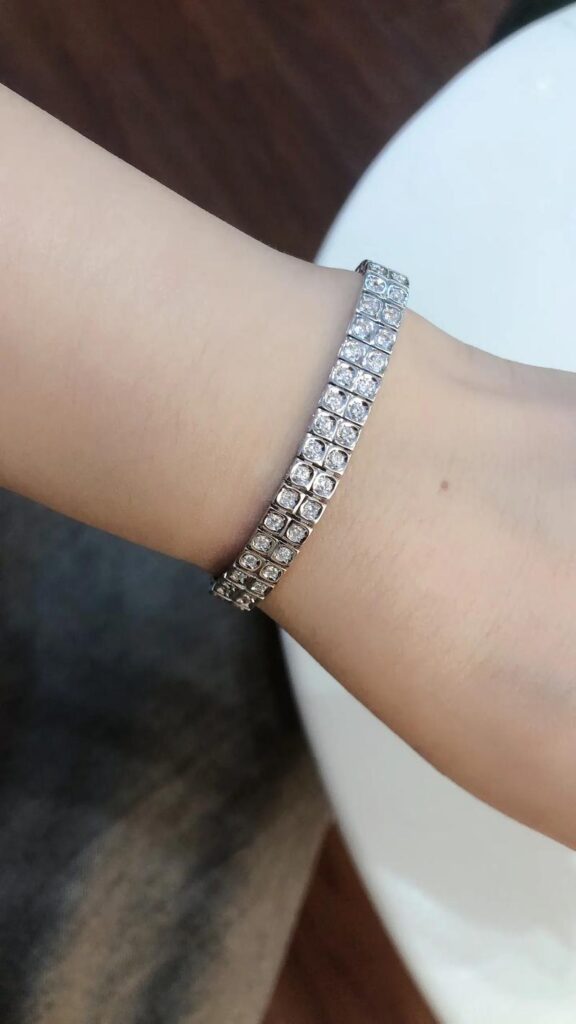
What Makes a Diamond Bracelet Different From Other Jewelry?
Bracelets have unique production requirements because they are designed to move with the wrist.
Unlike a stationary jewelry piece, a bracelet needs to balance appearance, flexibility, comfort, and durability. The individual components must work together while the wearer moves their wrist throughout the day.
This is particularly important for diamond bracelets with multiple stones.
A tennis bracelet, for example, consists of a continuous arrangement of diamonds that needs to maintain a consistent visual appearance while also allowing enough flexibility for comfortable wear.
The clasp must be secure and practical. The links or settings need to connect correctly. The diamonds should remain properly positioned. The polished surface should be consistent across the entire bracelet.
These requirements make specialized bracelet manufacturing experience valuable.
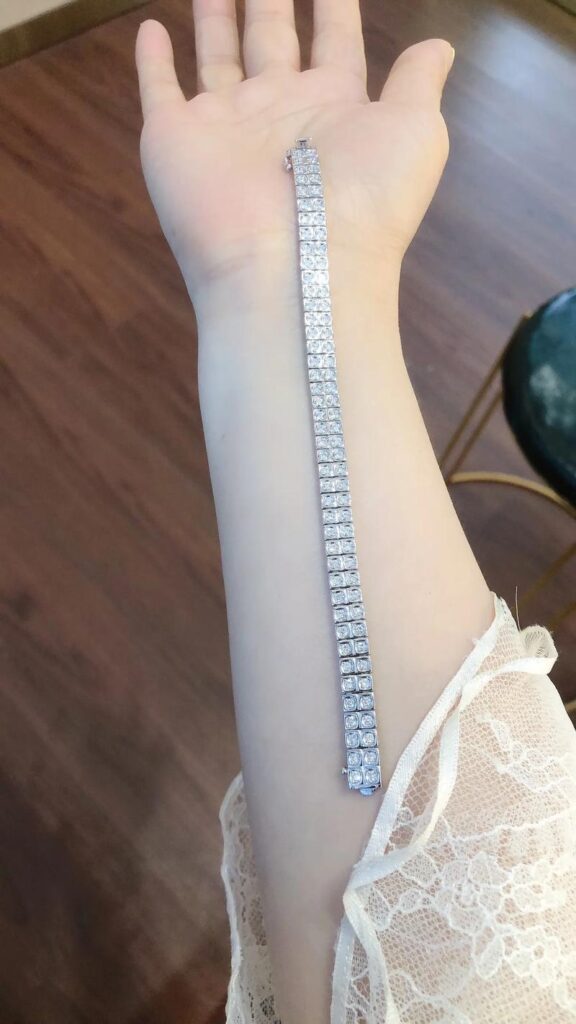
Custom Tennis Bracelet Manufacturing
The tennis bracelet remains one of the most recognizable diamond bracelet styles.
Its classic design is based on a continuous row of diamonds arranged around the wrist. However, modern brands can reinterpret the style in many ways.
A custom tennis bracelet can vary in:
- Diamond shape
- Diamond size
- Total carat weight
- Metal type
- Bracelet width
- Setting style
- Clasp construction
- Bracelet length
- Diamond arrangement
- Surface finish
For example, a brand may develop a delicate tennis bracelet using smaller stones for an understated everyday look. Another brand may create a more substantial version using larger diamonds and a heavier precious-metal structure for a luxury collection.
A specialized diamond bracelet manufacturer can help translate these concepts into practical production specifications.
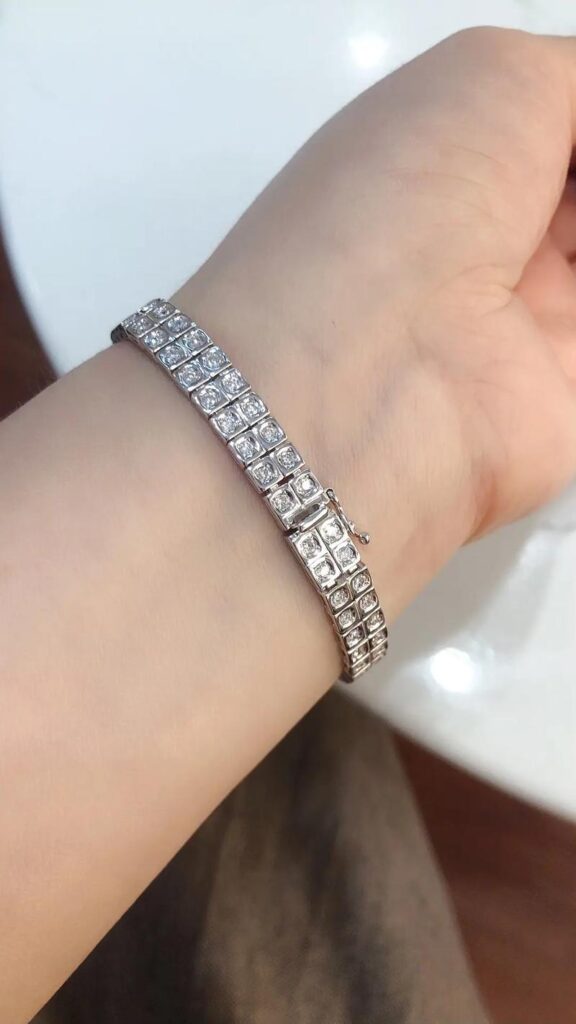
Choosing the Right Diamond Shape
Diamond shape has a major influence on the appearance of a bracelet.
Round diamonds are a traditional choice for tennis bracelets because of their classic appearance and brilliant light performance.
However, other shapes can create a distinctive design.
Possible options include:
- Round
- Oval
- Princess
- Emerald
- Pear
- Marquise
- Cushion
- Radiant
The shape should be selected according to the overall bracelet design.
For a classic collection, round diamonds may provide the most recognizable appearance. For a contemporary brand, elongated shapes such as oval or marquise diamonds may create a more distinctive visual identity.
A manufacturer can help determine how different diamond shapes affect the setting, spacing, dimensions, and production process.
Diamond Size and Bracelet Proportion
Choosing a diamond size is not simply a matter of selecting the largest stone that fits the budget.
The size of each stone affects the bracelet’s overall proportions, weight, appearance, flexibility, and production cost.
A delicate bracelet may require smaller stones positioned closely together. A statement bracelet may use larger stones with a wider setting.
The total carat weight also affects the product’s retail positioning.
For this reason, brands should determine the intended customer and price range before finalizing the diamond specifications.
A professional manufacturer can then help ensure that the diamond size, bracelet dimensions, metal weight, and setting structure work together.
Natural Diamonds vs. Lab-Grown Diamonds for Bracelets
Brands developing diamond bracelets often need to decide whether to use natural diamonds or lab-grown diamonds.
Natural diamonds are traditionally associated with fine jewelry and luxury products. They may be appropriate for brands emphasizing rarity, heritage, and traditional luxury positioning.
Lab-grown diamonds provide another option for brands seeking different pricing and product strategies.
The choice should depend on the brand’s target audience, retail positioning, budget, sourcing requirements, and product concept.
Incepto Jewel lists both natural diamonds and lab-grown diamonds among its bracelet manufacturing materials. It also offers moissanite, cubic zirconia, and natural gemstones for different jewelry requirements.
This range allows jewelry businesses to develop products for multiple market segments rather than being limited to a single stone category.
Selecting the Right Metal
The metal surrounding the diamonds contributes significantly to the final appearance of a bracelet.
Common choices include 925 sterling silver, 10K gold, 14K gold, and 18K gold.
925 Sterling Silver
Sterling silver can be suitable for contemporary jewelry brands and collections positioned at a more accessible price level.
It can also provide a bright, clean appearance that works well with many diamond bracelet designs.
10K Gold
10K gold provides a precious-metal option with a lower gold content than 14K or 18K gold.
It can be useful for brands seeking a balance between precious-metal positioning and production cost.
14K Gold
14K gold is a popular choice for jewelry collections because it offers a balance of appearance, durability, and precious-metal content.
18K Gold
18K gold is often used for higher-end jewelry collections and luxury product positioning.
Incepto Jewel lists 925 sterling silver and 10K, 14K, and 18K gold among its bracelet manufacturing materials.
The Importance of Bracelet Construction
The quality of a diamond bracelet depends not only on the diamonds but also on its underlying structure.
A bracelet must have enough strength to withstand regular movement while maintaining the intended appearance.
For flexible designs, the individual links or settings need to move smoothly.
For more structured designs, the metal construction must provide appropriate support.
The clasp also deserves careful attention.
A clasp that is too difficult to operate can reduce the customer’s experience, while an insecure clasp can create a serious product problem.
During the prototype stage, brands should test how easily the bracelet opens and closes and whether it remains secure during movement.
CAD Design for Custom Bracelet Development
3D CAD has become an important part of modern jewelry manufacturing.
Instead of moving directly from an idea to mass production, designers and manufacturers can create a detailed digital model first.
A CAD model can help evaluate:
- Bracelet dimensions
- Diamond placement
- Metal thickness
- Link structure
- Clasp construction
- Overall proportions
- Logo placement
- Manufacturing feasibility
This process is especially useful when developing a completely new bracelet design.
Incepto Jewel lists 3D CAD design as part of its bracelet manufacturing capabilities, allowing custom jewelry concepts to be developed before physical sampling.
Why Prototype Sampling Matters
A digital model cannot completely replace a physical sample.
Once a bracelet is produced, the brand can evaluate details that are difficult to judge from a computer screen.
The sample can be worn and inspected for:
- Comfort
- Weight
- Flexibility
- Diamond appearance
- Clasp function
- Bracelet length
- Surface finish
- Overall proportions
If the bracelet feels too heavy, too rigid, too loose, or visually different from the intended design, adjustments can be made before bulk production.
This is one of the most effective ways to reduce production risk.
Quality Control for Diamond Bracelets
Quality control should be integrated throughout the manufacturing process.
For diamond bracelets, important inspection areas include the raw materials, dimensions, diamond placement, stone security, polishing, plating, clasp function, and final appearance.
Incepto Jewel describes a multi-stage quality-control system that includes raw material inspection, dimension verification, stone security testing, surface finish inspection, plating thickness testing, final appearance inspection, and packaging inspection.
For brands, this type of structured process can help maintain consistency across production batches.
Consistency becomes particularly important for repeat orders.
If a bracelet becomes a bestseller, the second production batch should match the approved first batch as closely as possible.
Custom Branding for Private Label Bracelets
A bracelet can become a stronger commercial product when it is integrated into the overall brand identity.
Private label manufacturing allows businesses to incorporate branding into both the jewelry and its packaging.
Possible customization includes:
- Logo engraving
- Custom clasp details
- Branded jewelry boxes
- Gift bags
- Product tags
- Care cards
- Instruction cards
- Retail packaging
Incepto Jewel offers private label services that can include logo engraving and branded jewelry packaging.
This can be particularly valuable for online jewelry companies because packaging becomes an important part of the customer’s first physical interaction with the brand.
Small-Batch Production for New Collections
Not every jewelry business wants to start with a large order.
For startups and emerging brands, a smaller production run can provide an opportunity to test a new design.
Incepto Jewel lists a typical bracelet MOQ of 30–50 pieces depending on project requirements.
A brand can use an initial batch to evaluate:
- Customer demand
- Retail pricing
- Product reviews
- Repeat purchase behavior
- Social media engagement
- Sales performance
If the product performs well, the company can increase production.
This approach can make custom jewelry development more manageable for businesses that are still building their customer base.
Scaling From Small Orders to Wholesale Production
A manufacturer should also be capable of supporting larger orders when demand increases.
For example, a startup may initially order 50 pieces of a bracelet. After the design becomes successful, the business may require hundreds or thousands of pieces for wholesale distribution.
This is why production capacity should be evaluated before selecting a long-term manufacturing partner.
Incepto Jewel states that its bracelet manufacturing facility has more than 5,000 square meters of production space, over 100 skilled workers, and a monthly bracelet production capacity exceeding 100,000 pieces.
Scalable capacity can help brands transition from product testing to larger commercial orders without immediately changing suppliers.
What Does a Custom Diamond Bracelet Cost?
The cost of a custom bracelet depends on multiple factors.
The most important variables include:
- Diamond type
- Total diamond carat weight
- Diamond quality
- Metal type
- Metal weight
- Bracelet size
- Setting style
- Design complexity
- Order quantity
- Packaging requirements
For example, an 18K gold tennis bracelet with premium natural diamonds will have a very different production cost from a sterling silver bracelet featuring smaller lab-grown diamonds.
There is therefore no meaningful universal price for a custom diamond bracelet without product specifications.
When requesting a quotation, brands should provide a detailed product brief so the manufacturer can calculate the production requirements accurately.
How Long Does Custom Bracelet Manufacturing Take?
Production time depends on the complexity of the design and the order requirements.
Incepto Jewel currently lists approximately 1–3 days for CAD design, 7–15 days for sample production, and 15–30 days for bulk production, although the actual timeline should be confirmed for each individual project.
The overall project schedule may also include time for design revisions, material confirmation, sample approval, packaging, inspection, and shipping.
For seasonal collections, brands should therefore begin the development process early enough to allow time for revisions and production.
How to Choose a Reliable Diamond Bracelet Manufacturer
Before selecting a factory, ask for information about its:
Manufacturing Experience
Does the factory have experience producing diamond bracelets and other fine jewelry?
Design Capabilities
Can it develop CAD models and prototypes from your concept?
Material Options
Can it supply the metals and diamond types required for your collection?
MOQ
Is the minimum order appropriate for your business?
Production Capacity
Can the factory handle larger orders if your collection grows?
Quality Control
Are there defined inspection procedures?
Branding
Can the manufacturer provide custom logos and private label packaging?
Documentation
Can it provide the documents required for your target market?
Shipping
Does the manufacturer have experience with international delivery?
Evaluating these factors together gives buyers a much better understanding of a manufacturer’s capabilities than comparing unit prices alone.
Frequently Asked Questions
What is a custom diamond bracelet manufacturer?
A custom diamond bracelet manufacturer produces bracelets according to a customer’s design, material, gemstone, dimensions, branding, and production requirements. Services may include CAD design, sampling, manufacturing, stone setting, quality inspection, and packaging.
Can a manufacturer make custom tennis bracelets?
Yes. Custom tennis bracelets can be developed with different diamond shapes, sizes, metals, settings, bracelet lengths, and clasp structures.
Can I choose between natural and lab-grown diamonds?
Yes. Incepto Jewel lists both natural diamonds and lab-grown diamonds among its bracelet manufacturing materials.
Can I order a small batch?
Yes. Incepto Jewel currently lists a typical MOQ of 30–50 pieces depending on project specifications, which can be suitable for startups and brands testing new collections.
Can the bracelet include my logo?
Yes. Private label services can include custom logo engraving and branded packaging, subject to the specific design and production requirements.
Does the manufacturer handle international orders?
Incepto Jewel states that it supports global shipping and serves customers across international markets.
Create Your Next Custom Diamond Bracelet Collection
A successful bracelet collection begins with a strong concept but depends on reliable execution.
The right diamond bracelet manufacturer can help transform an initial design into a finished product through CAD development, prototyping, material selection, precision stone setting, polishing, quality inspection, branding, packaging, and international delivery.
For jewelry brands, private label businesses, wholesalers, retailers, and online stores, custom manufacturing provides the flexibility to create distinctive products while maintaining control over specifications and brand identity.
Incepto Jewel offers OEM, ODM, private label, wholesale, and bulk bracelet manufacturing services, supporting custom designs from initial development through mass production. Its capabilities include 3D CAD design, CNC processing, lost-wax casting, precision stone setting, polishing, laser engraving, quality inspection, customized packaging, and global shipping.
Whether you are developing a classic tennis bracelet, a modern diamond chain bracelet, or an entirely new jewelry concept, an experienced manufacturing partner can help turn the design into a commercially ready product.
Incepto Jewel — Your Diamond Bracelet Manufacturer for Custom Jewelry, OEM, ODM, Wholesale, and Private Label Production.
