Building a successful jewelry brand requires more than finding attractive products to sell. Customers increasingly look for jewelry that has a distinctive identity, consistent quality, and a memorable brand experience. For businesses entering the fine jewelry market, working with an experienced diamond bracelet manufacturer can provide the production support needed to develop a unique collection under their own brand.
Private label jewelry manufacturing allows companies to create products that reflect their own design direction while relying on an established factory for production. Instead of investing in machinery, production facilities, and a large manufacturing team, a jewelry business can work with a specialized manufacturing partner for product development, sampling, diamond setting, finishing, quality inspection, packaging, and shipping.
For startups, online jewelry stores, wholesalers, fashion retailers, and established jewelry companies, this approach can provide flexibility throughout different stages of business growth.
Incepto Jewel provides OEM, ODM, private label, wholesale, and bulk jewelry manufacturing services, supporting customized bracelet production from design development through final delivery.
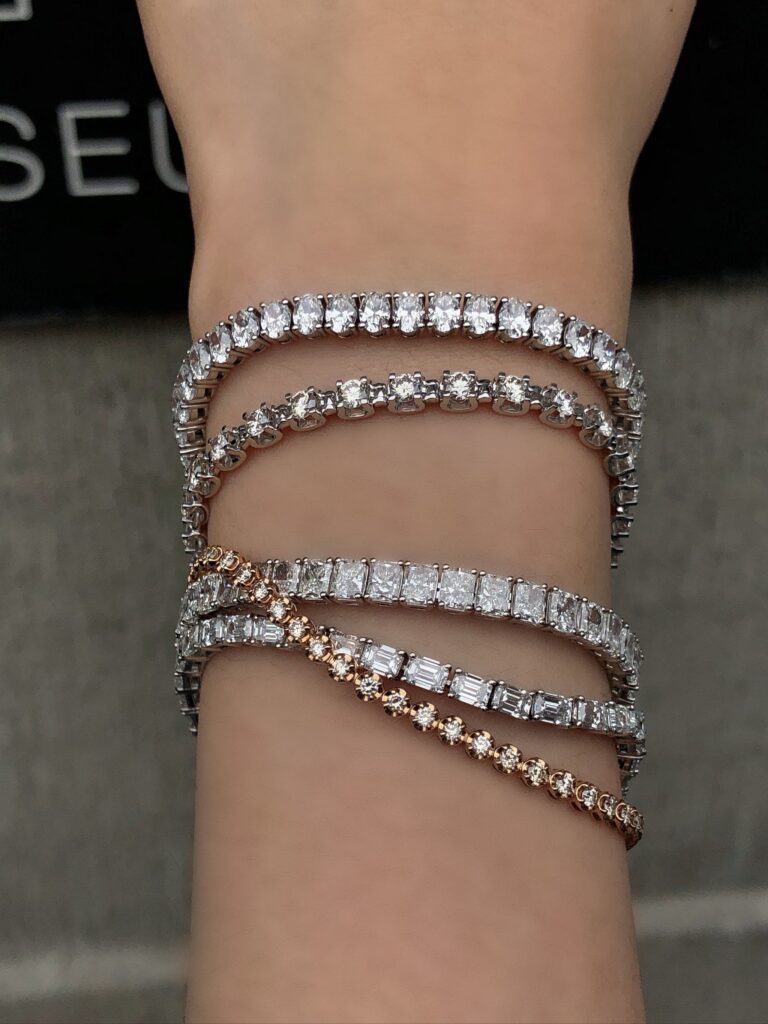
What Is Private Label Diamond Bracelet Manufacturing?
Private label manufacturing means that a factory produces jewelry according to the requirements of a brand, while the finished products are sold under the brand’s own identity.
The manufacturer handles the production process, while the jewelry company controls important elements such as product positioning, design direction, branding, packaging, pricing, and sales.
A private label diamond bracelet may include:
- Custom bracelet designs
- Natural diamonds
- Lab-grown diamonds
- 925 sterling silver
- 10K, 14K, or 18K gold
- Custom dimensions
- Personalized settings
- Logo engraving
- Branded packaging
- Custom product cards
- Retail presentation
This allows businesses to develop jewelry that feels unique without establishing their own factory.
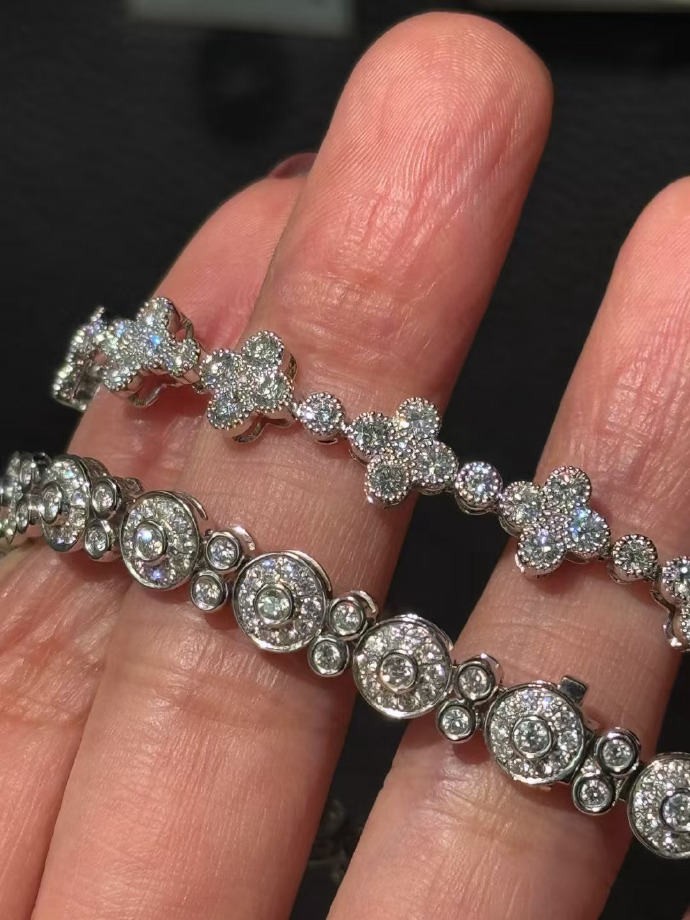
Why Private Label Is Attractive for Jewelry Brands
Traditional wholesale jewelry often involves selecting products that are already available from a supplier.
The main advantage is simplicity. Products are already developed and ready to order.
However, there is a major limitation: the same or very similar products may be available to other retailers.
Private label manufacturing provides greater control.
A brand can develop a bracelet specifically for its own customer base.
For example, a company targeting minimalist jewelry customers could create a slim diamond bracelet with subtle branding and lightweight construction. A luxury brand could develop a larger tennis bracelet using premium diamonds and 18K gold.
The products can be designed around the brand instead of forcing the brand to adapt to an existing catalog.
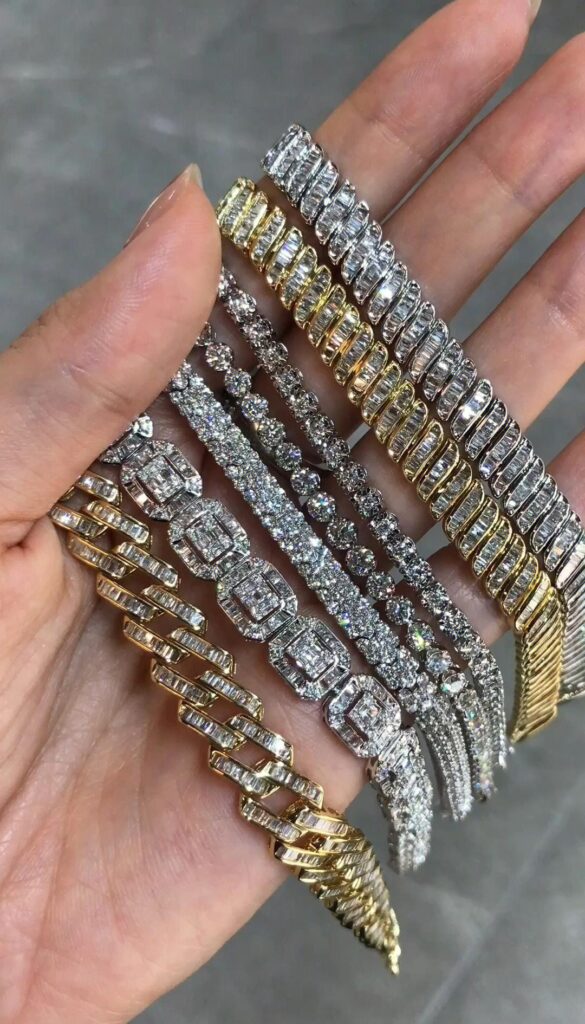
Start With a Clear Brand Concept
Before approaching a diamond bracelet manufacturer, determine what your jewelry brand represents.
A clear brand concept can make product development much easier.
Consider questions such as:
- Who is the target customer?
- What price range will the brand occupy?
- Is the style minimalist, classic, fashion-forward, or luxury?
- Will the collection focus on everyday jewelry or special occasions?
- Will the products use natural diamonds, lab-grown diamonds, or both?
- Which metals will define the collection?
- What visual elements should appear across different products?
For example, a contemporary jewelry brand may choose clean geometric designs, while a classic fine jewelry brand may focus on traditional diamond settings and precious metals.
The manufacturer can then use these requirements as a foundation for product development.
Developing a Signature Diamond Bracelet
A strong private label collection often begins with one or more signature products.
A diamond bracelet can become a signature item when its design contains recognizable characteristics that distinguish it from competing products.
These characteristics might include:
- A unique clasp
- A distinctive diamond arrangement
- A special link structure
- A recognizable bracelet profile
- Custom engraving
- A consistent metal finish
- A signature packaging style
The objective is not simply to make the bracelet different for the sake of being different. The design should support the brand’s identity while remaining practical and commercially attractive.
An experienced manufacturer can help determine whether the proposed design can be produced efficiently and whether structural changes are necessary.
OEM, ODM, or Private Label?
Businesses sometimes use these terms interchangeably, but they represent different approaches.
OEM Manufacturing
OEM is generally suitable when the brand has its own detailed design or specifications.
The factory manufactures the product according to those requirements.
This gives the brand significant control over the final product.
ODM Manufacturing
ODM is useful when the manufacturer provides design or product development support.
The business may start with a concept and work with the factory to create the final product.
This can be useful for brands without an internal jewelry design or engineering team.
Private Label Manufacturing
Private label focuses on producing jewelry that carries the brand’s identity.
It can involve custom designs, logo engraving, branded packaging, and other elements that create a consistent branded product.
Incepto Jewel provides OEM, ODM, and private label jewelry manufacturing services, allowing different types of businesses to choose the production model that best fits their requirements.
Choosing Diamonds for a Private Label Collection
Diamond selection should be consistent with the brand’s market position.
Natural diamonds may be appropriate for collections positioned around traditional fine jewelry and luxury.
Lab-grown diamonds can provide another option for businesses developing products at different price points.
Neither option is automatically better for every brand.
The decision should be based on:
- Target customer
- Retail price
- Product positioning
- Diamond specifications
- Sourcing requirements
- Collection strategy
Incepto Jewel lists both natural diamonds and lab-grown diamonds among the materials available for bracelet manufacturing.
For brands offering multiple product categories, using different diamond options can also allow the company to build several collections at different price levels.
Selecting Metals for Your Brand Identity
The metal used in jewelry can become part of a brand’s visual language.
For example, a company may use yellow gold consistently across its signature products, while another may focus primarily on white gold or silver-colored finishes.
Incepto Jewel lists 925 sterling silver, 10K gold, 14K gold, and 18K gold among its bracelet manufacturing materials.
The choice of metal affects:
- Appearance
- Durability
- Weight
- Production cost
- Retail price
- Customer perception
When developing a private label collection, it can be useful to establish a consistent metal strategy across bracelets, rings, necklaces, and earrings.
This creates a stronger visual connection between different product categories.
Custom CAD Design for Private Label Bracelets
CAD is particularly useful when a private label brand wants to develop a product that does not already exist in a standard catalog.
A 3D CAD model can help the manufacturer and buyer review the design before producing a physical sample.
Important elements can include:
- Bracelet length
- Width
- Thickness
- Diamond position
- Stone size
- Setting structure
- Clasp design
- Logo placement
- Overall proportions
The digital design can be revised before production.
Incepto Jewel lists 3D CAD design as part of its manufacturing capabilities, supporting the development of custom jewelry products.
Why Sampling Is Essential
A sample is the first physical representation of a private label design.
It should be treated as an important quality and development checkpoint.
During the sample stage, brands should examine the bracelet from both a visual and practical perspective.
Check whether:
- The bracelet fits correctly
- The length is appropriate
- The diamonds are positioned accurately
- The clasp works smoothly
- The bracelet feels comfortable
- The metal finish matches expectations
- The engraving is clear
- The overall appearance matches the brand concept
If changes are necessary, communicate them before approving the final production specifications.
This process helps create a clear standard for future orders.
Building Consistency Across Repeat Orders
For a private label brand, consistency is essential.
Customers who purchase a product again should receive a bracelet with the same appearance and quality as the original.
This is why the approved sample and final production specifications should be maintained as a reference.
Important specifications can include:
- Exact dimensions
- Metal type
- Metal weight
- Diamond requirements
- Setting details
- Finishing
- Logo placement
- Packaging
A reliable manufacturer should use these specifications when producing repeat orders.
Low MOQ for New Jewelry Brands
Private label does not always require large production quantities.
New jewelry businesses often want to test designs before investing heavily in inventory.
Incepto Jewel currently lists a typical bracelet MOQ of 30–50 pieces depending on project requirements.
A smaller initial order can allow a brand to test:
- Product demand
- Retail pricing
- Customer feedback
- Marketing response
- Sales conversion
- Repeat purchase behavior
Once a design proves successful, the company can increase production.
This makes flexible MOQ particularly valuable for emerging jewelry brands.
Scaling a Private Label Bracelet Business
A manufacturer should be able to support the business as it grows.
The first stage may involve only a few custom bracelet designs.
Later, the brand may develop:
- Additional bracelet styles
- Matching necklaces
- Diamond rings
- Earrings
- Seasonal collections
- Limited-edition products
- Wholesale collections
A manufacturer with broad jewelry production capabilities can potentially support these expansions.
Incepto Jewel states that its manufacturing facility covers more than 5,000 square meters and has more than 100 skilled workers, with a monthly bracelet production capacity exceeding 100,000 pieces.
This type of production capacity can provide room for businesses to scale their orders as demand increases.
Private Label Packaging Creates a Complete Brand Experience
Packaging should be considered during product development rather than added at the end.
For a jewelry business, the package can communicate the brand’s positioning before the customer even sees the bracelet.
Private label packaging may include:
- Custom jewelry boxes
- Branded gift bags
- Product tags
- Care cards
- Instruction cards
- Logo stickers
- Retail packaging
Incepto Jewel provides private label packaging options including branded jewelry boxes, gift bags, product tags, instruction cards, and other customized presentation materials.
For e-commerce businesses, professional packaging can be particularly important because the customer receives the product directly rather than experiencing it in a physical store.
Quality Control for Private Label Diamond Bracelets
A private label brand is ultimately responsible for the customer experience, even when manufacturing is outsourced.
That makes factory quality control especially important.
Incepto Jewel states that its bracelet production quality checks include raw material inspection, dimension verification, stone security testing, surface finish inspection, plating thickness testing, final appearance inspection, and packaging inspection.
These inspections help identify potential issues before products reach customers.
For diamond bracelets, stone security deserves particular attention.
A manufacturer should check that diamonds are properly positioned and securely held within their settings.
The clasp and moving components should also be inspected because bracelet construction involves repeated movement during normal wear.
Managing Cost Without Sacrificing Quality
Private label brands need to balance product quality with retail pricing.
The cost of a diamond bracelet depends on several factors, including:
- Diamond type
- Diamond carat weight
- Diamond quality
- Metal type
- Metal weight
- Design complexity
- Setting method
- Bracelet size
- Order quantity
- Packaging
A manufacturer can help identify opportunities to optimize the design.
For example, adjusting bracelet dimensions, stone size, or metal weight may affect the production cost without fundamentally changing the product concept.
However, cost reduction should not compromise essential quality characteristics such as stone security, structural integrity, or finishing.
International Production and Shipping
Many private label jewelry businesses sell internationally.
For these companies, manufacturing is only one part of the supply chain.
The finished products also need to be packaged, documented, and shipped to the destination market.
Incepto Jewel states that it provides global shipping and supports international logistics and customs documentation. The company also reports serving customers across more than 50 countries.
Experience with international orders can help simplify communication between production and delivery.
How to Find the Right Diamond Bracelet Manufacturer
When evaluating potential manufacturers, compare more than price.
A useful supplier evaluation should include:
Product Quality
Review samples carefully and inspect materials, stone setting, finishing, and construction.
Customization
Confirm that the factory can manufacture your specific design rather than only offering standard products.
MOQ
Check whether the minimum quantity fits your business model.
Production Capacity
Make sure the manufacturer can handle larger orders if your products become successful.
Development Support
Ask whether CAD design and prototype production are available.
Quality Control
Understand how products are inspected before shipment.
Branding
Confirm whether logo engraving and customized packaging are available.
Lead Time
Request realistic production schedules for samples and bulk orders.
Communication
Evaluate how clearly and quickly the manufacturer responds to technical questions.
These factors together provide a more accurate picture of the factory’s suitability.
Frequently Asked Questions
What is a private label diamond bracelet manufacturer?
A private label diamond bracelet manufacturer produces bracelets for a brand according to agreed product and branding specifications. The jewelry is then sold under the customer’s own brand.
Can I create a completely original bracelet?
Yes. A manufacturer with custom development capabilities can work from sketches, reference images, CAD files, or technical specifications to create an original bracelet.
Can private label bracelets use natural diamonds?
Yes. Natural diamonds can be used in private label bracelet production. Lab-grown diamonds are another available option depending on the manufacturer’s capabilities.
Can I order only 30–50 pieces?
Incepto Jewel currently lists a typical MOQ of 30–50 pieces for bracelet manufacturing, depending on the project.
Can I add my logo to the bracelet?
Yes. Private label services can include custom logo engraving, subject to the bracelet design and manufacturing requirements.
How long does production take?
Incepto Jewel lists approximately 1–3 days for CAD design, 7–15 days for sample production, and 15–30 days for bulk production. Actual timing depends on the specific project.
Build a Strong Private Label Jewelry Brand With the Right Manufacturer
Private label manufacturing gives jewelry businesses an opportunity to create distinctive products without investing in their own production facility.
However, the success of this model depends heavily on choosing the right manufacturing partner.
A capable diamond bracelet manufacturer should be able to support the entire product journey, including design development, CAD modeling, prototyping, material selection, diamond setting, finishing, quality inspection, branding, packaging, and delivery.
For startups, private label brands, online jewelry stores, wholesalers, retailers, and established jewelry companies, flexible manufacturing can make it easier to launch new designs, test customer demand, and scale successful products.
Incepto Jewel provides OEM, ODM, private label, wholesale, and bulk bracelet manufacturing services with capabilities covering custom design, 3D CAD, CNC processing, lost-wax casting, precision stone setting, polishing, laser engraving, quality control, customized packaging, and international shipping.
If you are planning to launch a private label diamond bracelet collection, developing a signature tennis bracelet, or expanding an existing jewelry business, the right manufacturing partner can help transform your ideas into consistent, market-ready products.
Incepto Jewel — Custom Diamond Bracelet Manufacturer for Private Label Jewelry Brands, Wholesalers, Retailers, and Online Businesses.
